




In addition to English, I write in Urdu also. Recently my article in Urdu on ship breaking was published in a magazine “PESHWA INTERATIONAL” from London. It occurred to me that I should write on this subject in English also and could be added to the book,” MY BANGLADESH” I am grateful to my dear friend Sajid Hussain Sahib (Ex-Commandant, Bangladesh Marine Academy) who kindly gave me sufficient information about ship breaking industry in Bangladesh.
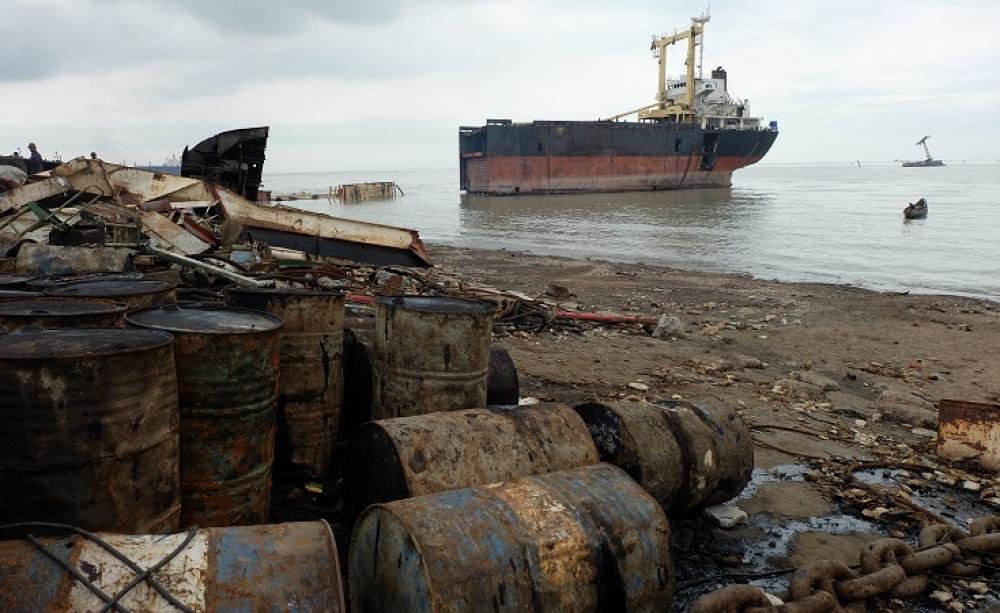
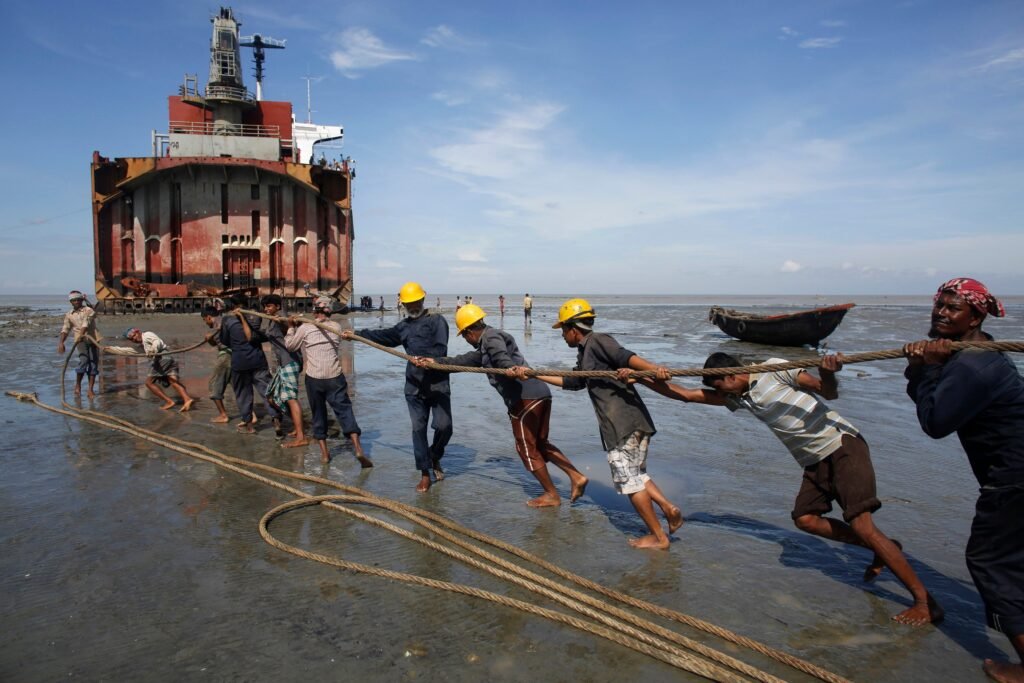
Ship breaking is a big industry. After running for 20-25 years, a merchant ship becomes old, and its repair/maintenance costs increase tremendously. The best option for the owner is to scrap the ship. There is a proverb in Urdu. “A live elephant is worth one lac (hundred thousand) rupees and a dead elephant is worth one a quarter lac rupees.” This proverb applies perfectly to ship breaking. It is interesting that not a single part a broken ship is wasted. When traders come to know of a ship to be scrapped, they select their items beforehand. For example, a trader comes and pays advance money for the entire wood of the ship. For breaking the ship, the first step is to beach it. This act takes place when there is high tide in the sea so that the ship may go on the ground as far as possible.
In years 1970 and 1980, Taiwan was number one ship in ship breaking. (Breaking of ships would start while still afloat). Pakistan had second position in this industry. At Gadani beach, there are one hundred yards. Being 35 miles away from Karachi, Gadani is part of Balochistan Province. However, custom duty on broken ships is received by the Federal Government.
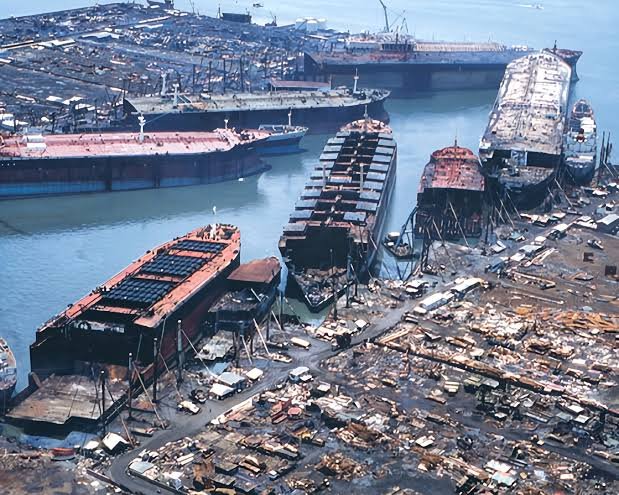
The present situation is that India is far ahead of other countries in ship breaking. The biggest beaching yard is located in Bhaonagar, Gujrat,(India). In this field, Bangladesh is competing with India. There are about seventy ship breaking yards located along the Sitakunda coast near Chattogram. These yards handle the dismantling of over 150 ships annually. The merchant ship consists mainly of mild steel which is melted to make steel rods used in building construction. According to a report, approximately 50–60 % of steel requirement of Bangladesh is met from ship breaking. There are more than 300 steel rerolling mills across the country. The use of recycled steel has reduced building construction costs. The biggest advantage of ship breaking industry is creation of jobs. In Bangladesh, about thirty to fifty thousand people work in this industry. In related industries and businesses, one to one and a half lac (100,000—150,000) people are employed.
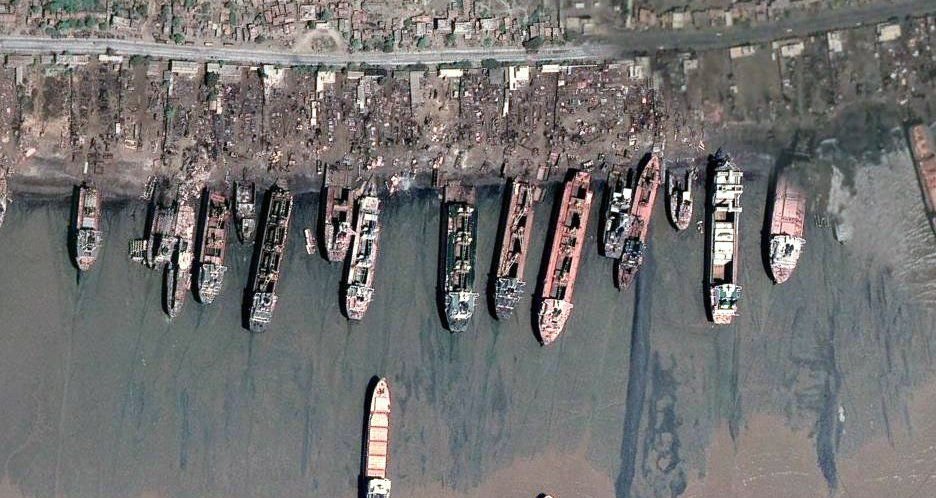
On broken ship, there are innumerable items which are all sold in the market. To name a few , furniture, sanitary items, different sizes of pipes, many electric motors and pumps, tools, spare parts, spare propeller and tail end shaft, welding equipments, cylinders of oxygen acetylene and freon. Also fuel oil and lubricating oil. There are two/three boats which are usable.
On board there are a minimum of three generators. The generators are old but due to continuous professional maintenance work like new. If a new generator costs two crore rupees, a ship’s generator could be purchased for forty or fifty lac rupees. Many factories (specially textile) in Pakistan and Bangladesh use these generators instead of buying electricity from Government organisations.
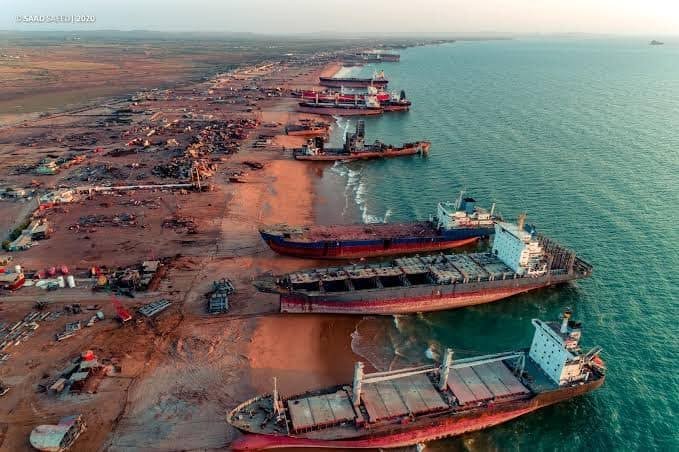
There are some problems also with ship recycling industry. For example, injuries to workers or sometimes death of a worker due to accident. In addition, air, land and sea pollution. To deal with these problems, an International Convention was held in Hong Kong in 2019. It is known as Hong Kong Convention. Some important decisions were taken for the safety of workers and reduction/elimination of pollution. In addition to many maritime nations, India, Pakistan and Bangladesh have signed this Protocol.
The key person in Bangladesh ship recycling industry is Captain Mohammad Anam Chowdhury. His contribution to this field is praiseworthy. Interestingly long ago, I called him from UK. His answer was, “I cannot speak to you as I am beaching a ship”. When I was serving as Chief Engineer on board M V Solidarity (renamed Banglar Kiron) in 1982, he was Second Officer with me. At present, Captain Anam Chowdhury also acts as President, Bangladesh Merchant Marine Officers Association (BMMOA).
I too have some experience in ship beaching. From Karachi the captain, myself and other Pakistani crew members flew to New Orleans (Louisiana, USA) and took control MV OZARK. It was a bulk carrier of 38,000 tonnes berthed on the bank of Mississippi River. The owners were Americans. My job was to act as Chief Engineer. There are some problems but by the grace of God Almighty, these were overcome. Initially there was too much work to do. We dealt with the Classification surveyor efficiently.
Finally, our ship sailed from New Orleans and reached New York. We loaded scrap steel for Karachi. On arrival, the ship occupied two berths due to its size at West Wharf, Karachi Port. Discharging cargo took about three weeks. We took the empty ship to Bhaonagar, Gujrat, (India). An Indian businessman had purchased the ship for scrapping. The ship was at anchor, and we were waiting for the full moon time to beach the ship. In the meantime, most of the crew members left the ship and returned to Karachi. Only seven persons remained on board for beaching. They were captain, second officer, deck cadet, myself, two third engineers and electrician. Finally with the help of pilot, we beached the ship safely. We seven individuals left the dead ship and travelled to Mumbai, to fly back to Karachi. Second time, I as chief engineer, brought a small ship from UAE and beached it in Mumbai.
Mubashir Ahmed (Khan); London 27.10.2026









Recent Comments